
A portable charger helps drivers recharge their vehicles. A Vehicle-to-Load (V2L) accessory allows a compatible vehicle to supply electricity to external devices. Combining these functions in one product creates an attractive opportunity for automotive accessory brands, vehicle dealers, and OEM buyers.
However, a successful product requires more than a charging connector and an output socket. The vehicle must support the intended function, the electrical configuration must suit the destination market, and users must understand how to switch between operating modes.
Before starting an OEM project, define the target vehicles, intended applications, charging requirements, and V2L output requirements separately. These decisions provide the foundation for product selection, sample testing, branding, and bulk procurement.
What Is a 2-in-1 EV Charging and Discharging Gun?
A 2-in-1 charging and discharging gun combines AC vehicle charging and V2L power output within one product configuration.
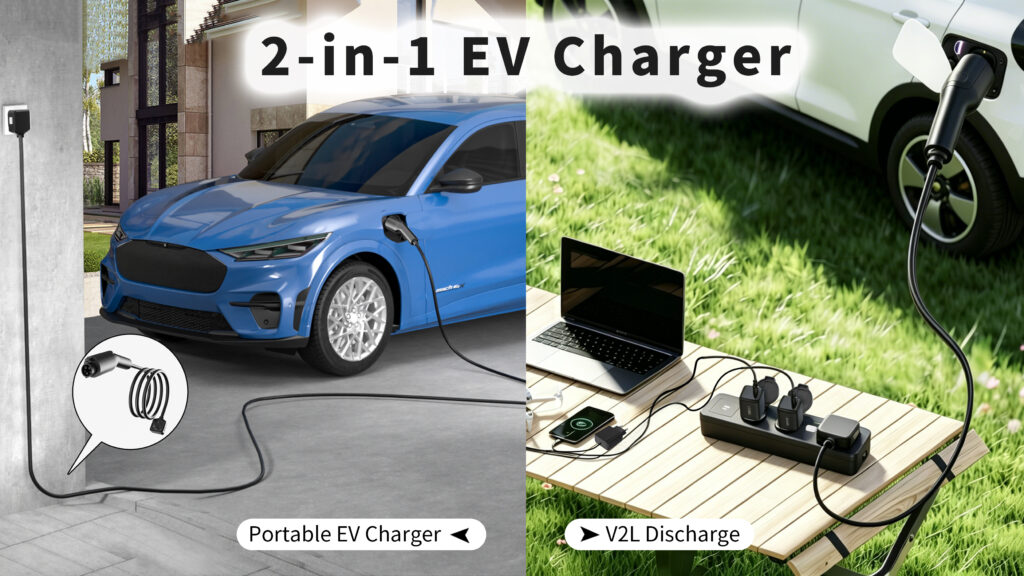
In charging mode, it connects a suitable external power supply to the vehicle. In V2L mode, it allows a supported vehicle to supply electricity to compatible external appliances.
| Operating Mode | Energy Direction | Typical Purpose |
|---|---|---|
| AC charging | External power supply → vehicle | Recharging the vehicle battery |
| V2L discharging | Supported vehicle → external appliance | Supplying power to suitable devices |
The two functions should have separate specifications. The advertised charging power must not be assumed to be the V2L output power.
A 2-in-1 description also does not establish that the equipment can charge the vehicle and power appliances simultaneously. Unless simultaneous operation is explicitly supported and documented, buyers should treat the functions as separate operating modes.
Which Business Buyers Can Benefit?
The product can serve several automotive accessory channels, but each needs a different configuration and sales message.
| Business Buyer | Potential Application | Main Procurement Priority |
|---|---|---|
| Automotive accessory brands | A branded charging and outdoor-power accessory | Ease of use, differentiation, packaging, and clear compatibility |
| Vehicle importers and dealers | Accessories supplied with compatible vehicles | Correct vehicle version, local plugs, and customer instructions |
| Camping and outdoor retailers | Power for suitable lighting, electronics, and appliances | Output limits, portability, and environmental conditions |
| Rental companies | An optional accessory for supported rental vehicles | Simple instructions, inspection, and replacement arrangements |
| OEM procurement teams | A defined product developed for a vehicle or accessory program | Approved specifications, validation evidence, and production consistency |
The product should be selected around an identifiable customer need. For example, a camping accessory package may prioritize convenient appliance connections, while a vehicle delivery package may prioritize local charging compatibility and straightforward instructions.
Confirm Vehicle Support Before Choosing the Connector
A connector that physically fits the vehicle does not prove that both charging and discharging will work.
For an AC V2L accessory, the vehicle must provide the required external power-output capability. Buyers should establish compatibility for the exact vehicle configuration rather than relying on a broad vehicle-brand claim.
The initial vehicle list should include:
- Vehicle manufacturer and model
- Model year and trim
- Country or market version
- Charging inlet type
- External V2L capability
- Relevant vehicle settings and software version, where applicable
Vehicle settings can affect operation. For example, Hyundai documents a battery discharge limit that can stop V2L operation once the selected battery level is reached. This illustrates why operating settings should form part of the evaluation.
For OEM projects, maintain a compatibility matrix that distinguishes tested, pending validation, and unsupported vehicle configurations.
Specify Charging and V2L Output Separately
A useful product specification clearly separates input charging requirements from output appliance requirements.
| Specification Area | AC Charging Requirements | V2L Output Requirements |
|---|---|---|
| Electrical ratings | Input voltage, frequency, current, and phase | Output voltage, frequency, current, and continuous power |
| Connections | Supply plug and vehicle connector | Appliance socket and approved accessories |
| Operating limits | Supply, cable, and vehicle charging limitations | Vehicle output limit, product limit, and connected load |
| User controls | Charging start, stop, and current selection, if provided | Output activation, shutdown, and status indication |
| Documentation | Charging instructions and installation conditions | Supported loads and discharging instructions |
The usable output is constrained by the vehicle, accessory, connections, and operating conditions. A higher rating on one component does not remove the limits of the others.
If the product has multiple output sockets, specify whether the stated power is the combined total or an allowance for each socket.
Match the Output to Real Appliances
“Suitable for outdoor use” is not a complete load specification. OEM buyers should identify the devices customers are expected to connect.
Lighting and small electronics can present different requirements from refrigerators, pumps, or power tools. Some appliances also draw a higher current during startup than during normal operation.
For sample evaluation, provide the supplier with:
- Appliance type and model
- Rated voltage and frequency
- Normal operating power
- Startup requirements, where relevant
- Expected operating duration
- Whether several appliances will run together
Avoid marketing the product as capable of powering every appliance. Vehicle manufacturers publish specific V2L restrictions; Hyundai, for example, advises against using V2L for equipment requiring an uninterrupted supply, such as medical equipment.
The final manual should explain permitted applications and load limits in language an ordinary driver can understand.
Define a Clear Mode-Switching Process
Mode switching is central to the user experience. Customers should be able to identify which mode is active and understand the correct connection sequence.
Before approving a sample, buyers should obtain a documented operating process covering:
- How charging and discharging modes are selected
- Which connections must be removed before changing modes
- Whether vehicle-screen settings are required
- What indicators show charging, output availability, and faults
- How operation stops and how the product returns to a safe state
The evaluation should also address foreseeable incorrect connections and how the equipment prevents unintended power paths.
Do not create generic switching instructions before the product design and approved operating sequence are confirmed. Packaging, quick-start guides, and demonstration videos should all follow the same validated process.
Select Plugs and Sockets for the Destination Market
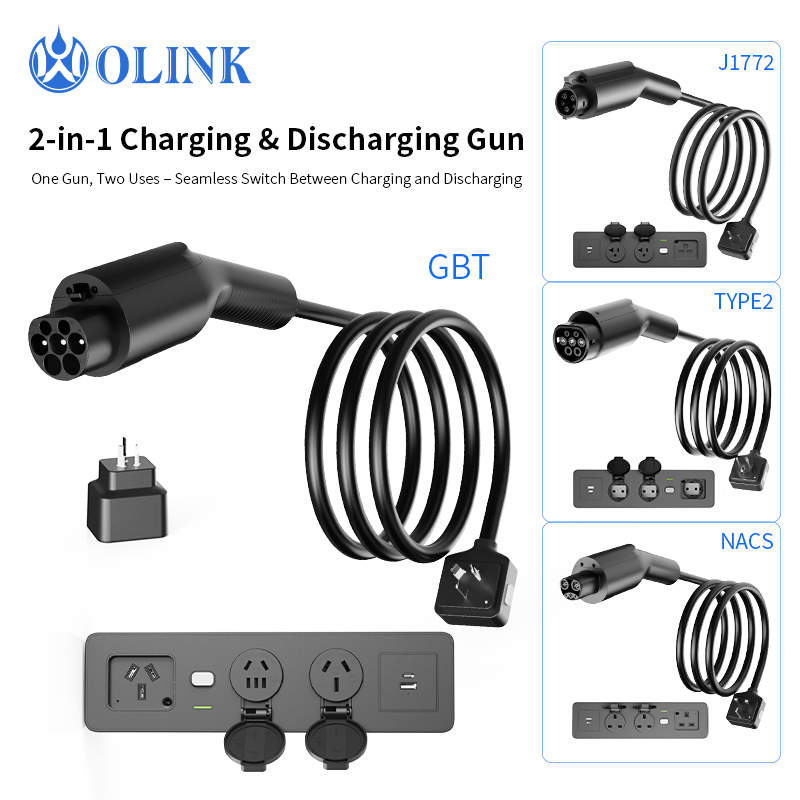
Vehicle connectors, input power plugs, and appliance sockets are separate configuration choices.
An OEM request should identify all three:
| Connection | What the Buyer Must Define |
|---|---|
| Vehicle side | Connector required by the target vehicle |
| Charging input | Power plug appropriate to the intended supply |
| V2L output | Appliance socket appropriate to the destination market |
A familiar socket shape does not establish that the voltage, frequency, earthing arrangement, or current rating is suitable.
For businesses selling in several countries, separate market-specific configurations may simplify product selection, labeling, documentation, and after-sales support.
Confirm Protection and Environmental Requirements
Protection requirements should be documented for both operating modes.
Buyers should request information on applicable temperature monitoring, overload response, fault indication, and protective shutdown behavior. The supplier should explain which protections belong to the accessory and which depend on the vehicle or electrical installation.
Environmental requirements should also cover the complete connection arrangement. An IP rating for an enclosure should not automatically be applied to uncovered sockets, power plugs, or every connected state.
Relevant project questions include:
- What operating temperatures are permitted?
- Under which connection conditions does the stated IP rating apply?
- How should unused sockets and connectors be protected?
- What inspection and cleaning instructions are required?
- What happens after a protective shutdown?
Protection testing should follow an agreed procedure and be conducted by qualified personnel.
Understand the Boundary Between V2L, V2H, and V2G
V2L, Vehicle-to-Home (V2H), and Vehicle-to-Grid (V2G) describe different applications.
| Term | Intended Application | OEM Procurement Implication |
|---|---|---|
| V2L | Supplying suitable external appliances | Confirm vehicle support, output limits, and appliance connections |
| V2H | Supplying a building through a compatible system | Requires a specifically designed and approved building-power arrangement |
| V2G | Exporting power to the electricity grid | Requires compatible equipment, controls, and applicable grid approvals |
A product described as “V2X” or “charging and discharging” should not automatically be presented as supporting V2H or V2G.
For a V2L accessory, marketing should focus on documented appliance-power applications. It should not imply that users can connect the output to a household wall socket or building distribution system.
Request Model-Specific Compliance Documents
The required documentation depends on the product configuration, destination market, and applicable requirements.
For an OEM project, request documents that identify the exact product being supplied. Check the model number, electrical ratings, applicant or manufacturer, and covered functions.
Particular attention should be given to whether the documentation addresses both charging and discharging operation.
Changes to the housing, cable, connector, socket, or electrical design may require further assessment. Private-label buyers should also agree on responsibility for product labels, declarations, manuals, and any additional testing.
A supplier’s general certification portfolio should not replace a review of the proposed model.
Approve a Sample Before Confirming Bulk Production
Sample approval should demonstrate that the product works as intended with representative vehicles and appliances.
| Evaluation Area | What to Verify |
|---|---|
| Vehicle compatibility | Charging and V2L operation on the agreed vehicle versions |
| Mode selection | Clear controls, indicators, and connection sequence |
| Charging performance | Operation under the specified input and vehicle conditions |
| V2L performance | Output with agreed appliances and combined loads |
| Vehicle settings | Behavior when a vehicle-controlled discharge limit is reached |
| Protection behavior | Results from the agreed qualified test procedure |
| Usability | Cable handling, socket access, carrying, and storage |
| Documentation | Labels, specifications, instructions, and packaging consistency |
Retain the approved sample configuration and record the conditions used during evaluation. This gives both parties a clearer reference for production and future orders.
OEM Requirements Checklist
Before requesting a quotation, prepare the following information:
| Requirement | Information to Provide |
|---|---|
| Target market | Sales country and customer group |
| Target vehicles | Model, year, trim, market version, and V2L capability |
| Charging configuration | Input supply, current, power, and plug |
| V2L configuration | Output voltage, frequency, socket, and required load |
| Operating process | Intended mode selection and user instructions |
| Physical requirements | Cable length, storage, housing, and accessories |
| Branding | Logo, colors, packaging, and manual languages |
| Documentation | Required model-specific compliance and test materials |
| Validation | Vehicles, appliances, and sample acceptance criteria |
| Commercial requirements | Sample quantity, order quantity, delivery, and warranty arrangements |
OLINK‘s 2-in-1 Charging and Discharging Solution
OLINK lists a 2-in-1 product combining AC charging and V2L output. Its product page identifies 3.5 kW and 7 kW AC charging configurations and lists Type 1, Type 2, NACS, and GB/T connector options. These published options do not establish V2L compatibility with every vehicle using those interfaces.
OLINK also advertises OEM/ODM services including housing logos, optional color finishes, and customized packaging. Buyers should request the specification for the proposed configuration, with charging and discharging ratings stated separately.
For automotive accessory brands and OEM procurement teams, the starting point is a defined vehicle list and application brief. These allow product selection and sample evaluation to focus on the intended customers.
Frequently Asked Questions
Does a 2-in-1 Product Add V2L to Any EV?
No. For an AC V2L accessory, the vehicle must support the required external power-output function. Connector fit alone is insufficient.
Is the Discharging Power the Same as the Charging Power?
Not necessarily. Charging and output ratings must be specified separately and checked against the vehicle’s capabilities.
Can It Charge the Vehicle and Power Appliances at the Same Time?
Do not assume so. Simultaneous operation must be explicitly supported and documented for the selected product and vehicle.
Can the Product Be Customized with Our Brand?
OLINK advertises logo, color, and packaging customization. Confirm the available scope, sample process, order quantity, and documentation requirements for the proposed model.
Does V2L Mean the Product Can Power a House?
V2L appliance output should not be treated as approval for connection to a building’s wiring. Building backup and grid export require specifically designed systems and applicable approvals.
Request Model-Specific Specifications from OLINK
Planning a branded charging and V2L accessory for your market?
Send OLINK your target country, vehicle list, charging requirements, intended appliances, output socket, estimated quantity, and branding needs.
Request model-specific specifications to review the proposed configuration, documentation, and sample evaluation requirements before moving to bulk procurement.
