As NACS becomes more common in North America, CCS1 vehicles and CCS1 charging stations do not need to be replaced immediately. The practical transition strategy is to support both standards during the migration period.
For charging operators, the key is not choosing NACS or CCS1 too early. The better approach is to build a flexible adapter and connector plan. This helps you serve existing CCS1 vehicles while preparing for new NACS-equipped EVs.
OLINK supports this transition with NACS and CCS1 related EV charging adapters. We help you reduce compatibility gaps, protect existing charger investment, and plan product inventory with a clearer roadmap.
What Is Changing in North American EV Charging?
North America is moving from a CCS1-dominant fast charging market toward a mixed NACS and CCS1 market. Many new EV models are expected to use NACS ports, while millions of existing vehicles still use CCS1.
This creates a transition period. During this period, charging sites may need to serve three user groups:
| User Group | Charging Need | Recommended Transition Path |
|---|---|---|
| Existing CCS1 vehicles | Access more NACS DC fast chargers | NACS to CCS1 adapter |
| Future NACS vehicles | Continue using existing CCS1 chargers | CCS1 to NACS adapter |
| Mixed vehicle fleets | Support both connector types | Dual-standard charger or adapter inventory |
For operators, the market will not switch overnight. CCS1 infrastructure still has value. NACS adoption simply changes how you should manage compatibility.
What Is the Difference Between NACS and CCS1?
NACS is the North American Charging Standard connector. It is compact and supports both AC and DC charging through the same physical connector design.
CCS1 is the Combined Charging System used widely by non-Tesla EVs in North America. It combines a J1772 AC section with two additional DC pins for fast charging.
The two standards are different at the connector level. However, many transition solutions are possible because the charging communication and power control can be managed through compatible adapter design.
For commercial charging projects, the important question is not only “Which connector is better?” The more useful question is: “Which connector mix helps us serve more vehicles during the transition?”
Should CCS1 Charging Projects Switch to NACS Immediately?
No. Most CCS1 charging projects should not remove CCS1 support immediately.
Existing CCS1 vehicles will remain on the road for many years. Fleet EVs, public charging users, used EV buyers, and commercial vehicles may continue to depend on CCS1 chargers.
A smarter strategy is phased transition:
Keep CCS1 charging capability for current users.
Add NACS support for new EV demand.
Use certified adapters where direct connector replacement is not necessary.
Track local vehicle mix before changing charger hardware.
Prepare separate inventory for vehicle-side and charger-side transition needs.
This approach helps charging operators avoid wasted hardware investment. It also reduces user complaints caused by connector mismatch.
Two Adapter Paths for the NACS Transition
Adapter direction is critical. A wrong adapter direction may cause failed charging, project delays, or inventory loss.
At OLINK, we recommend using a clear naming rule:
The first connector is the charger side. The second connector is the vehicle side.
Path 1: NACS to CCS1 Adapter
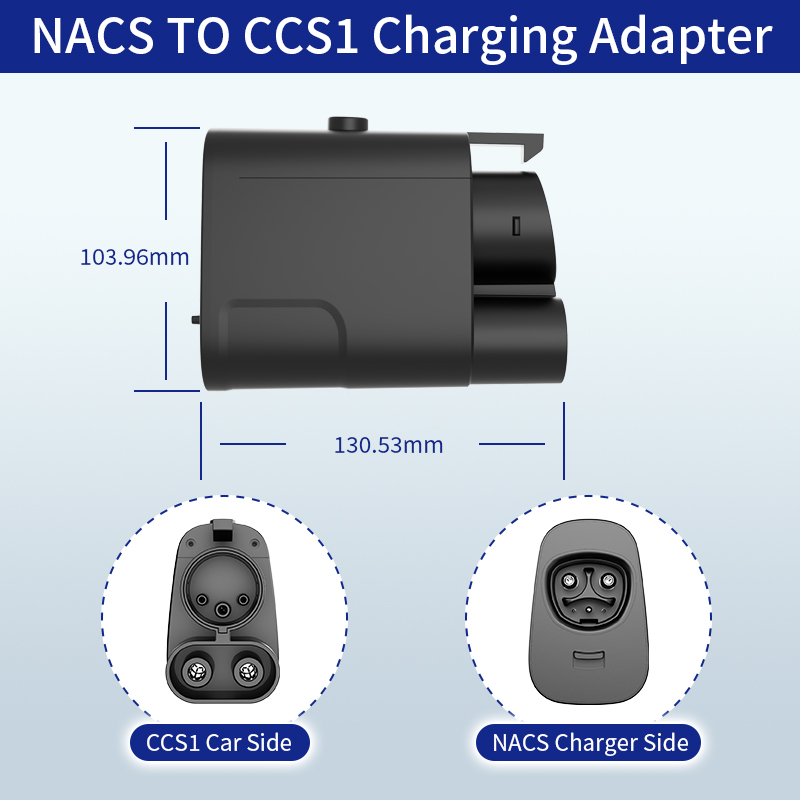
A NACS to CCS1 adapter is used when the charger side is NACS and the vehicle side is CCS1.
This path helps existing CCS1 vehicles charge at compatible NACS DC fast charging stations.
Typical use cases include:
| Charger Side | Vehicle Side | Adapter Direction | Example Scenario |
|---|---|---|---|
| NACS DC charger | CCS1 vehicle | NACS to CCS1 | CCS1 EV charging at NACS fast charger |
This is useful for operators serving Ford, GM, Rivian, Hyundai, Kia, Volkswagen, and other CCS1-based EV users during the transition period.
Path 2: CCS1 to NACS Adapter
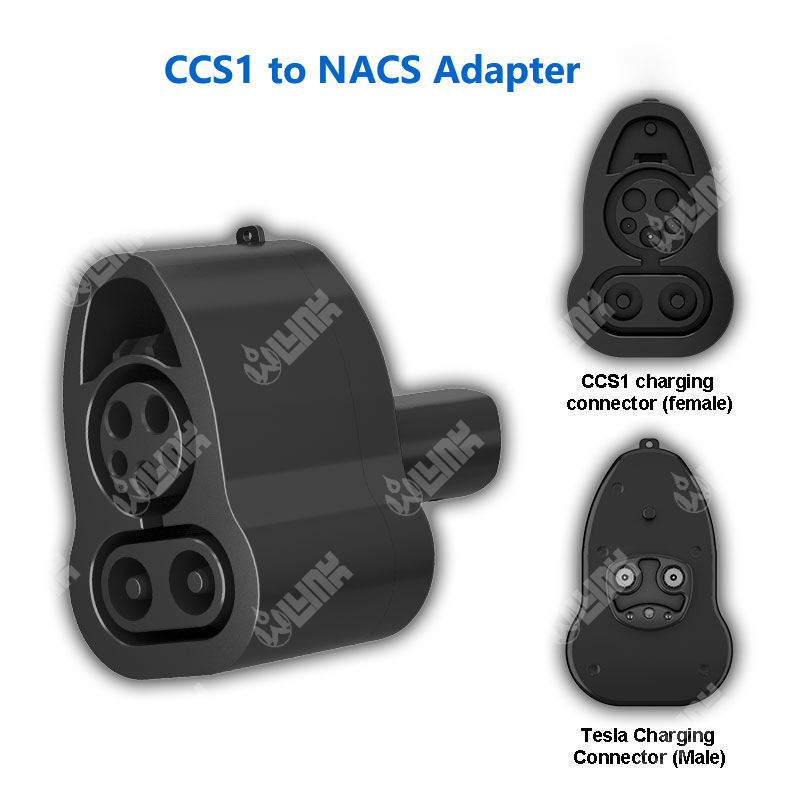
A CCS1 to NACS adapter is used when the charger side is CCS1 and the vehicle side is NACS.
This path helps future NACS vehicles use existing CCS1 DC fast chargers.
Typical use cases include:
| Charger Side | Vehicle Side | Adapter Direction | Example Scenario |
|---|---|---|---|
| CCS1 DC charger | NACS vehicle | CCS1 to NACS | NACS EV charging at CCS1 fast charger |
This path is important for charging operators with existing CCS1 stations. It protects earlier charger investment and helps the site serve newer NACS vehicles.
Why Adapter Direction Matters for Procurement
In the NACS transition, many purchasing mistakes come from unclear adapter direction.
For example, “CCS1 to NACS adapter” and “NACS to CCS1 adapter” are not the same product. They serve opposite charging scenarios.
Before purchasing, confirm these four points:
| Question | Why It Matters |
|---|---|
| What is the charger connector? | This determines the adapter input side. |
| What is the vehicle inlet? | This determines the adapter output side. |
| Is it AC or DC charging? | DC fast charging adapters cannot replace AC adapters. |
| What voltage and current are required? | Underrated adapters create safety and performance risks. |
For commercial projects, this confirmation should happen before sampling, bulk purchase, or site deployment.
How Should Charging Operators Plan Inventory?
Charging operators should avoid stocking only one adapter type too early. A balanced inventory plan is safer.
A practical transition inventory can include:
| Project Situation | Recommended Inventory |
|---|---|
| Existing CCS1 chargers, more NACS vehicles expected | CCS1 to NACS adapters |
| Nearby NACS network expansion, many CCS1 vehicles remain | NACS to CCS1 adapters |
| Public charging sites with mixed users | Both adapter directions |
| Fleet charging with fixed vehicle models | Match adapters to vehicle inlet type |
| New charger deployment | Consider dual-connector or NACS-ready hardware |
Inventory planning should follow real vehicle data. Do not only follow market headlines. The local vehicle mix decides the actual adapter demand.
What Should You Check Before Selecting a NACS Transition Adapter?
A commercial adapter should not be selected only by connector shape. It should be evaluated as an electrical safety component.
Check these factors before procurement:
| Selection Factor | Professional Requirement |
|---|---|
| Rated voltage | Match the charger and vehicle platform |
| Rated current | Support expected DC fast charging load |
| Temperature control | Reduce overheating risk under high current |
| Locking structure | Prevent accidental disconnection |
| Communication compatibility | Support stable charging handshake |
| Material | Use flame-retardant and durable housing |
| Protection level | Support outdoor and commercial environments |
| Testing process | Verify repeated plug-in cycles and load performance |
For commercial charging operators, adapter reliability directly affects charging success rate and user trust.
How OLINK Supports the NACS and CCS1 Transition
As an EV charging manufacturer, OLINK provides EV charging adapter solutions for North American charging projects. Our product coverage includes NACS and CCS1 transition needs for commercial operators, fleet charging, and cross-standard charging scenarios.
OLINK can support:
| OLINK Solution | Transition Value |
|---|---|
| NACS to CCS1 adapter | Helps CCS1 vehicles access NACS DC charging |
| CCS1 to NACS adapter | Helps NACS vehicles use CCS1 DC chargers |
| CCS1 related adapter solutions | Supports existing North American charging infrastructure |
| NACS related adapter solutions | Prepares projects for the new connector trend |
| Custom adapter matching support | Reduces procurement direction mistakes |
Our team can help you confirm charger-side and vehicle-side direction before production. This helps avoid wrong inventory and improves project deployment efficiency.
Recommended Transition Strategy for CCS1 Charging Projects
For a commercial charging project, the best transition plan is usually not a full replacement. It is a controlled compatibility upgrade.
Use this three-step strategy:
Step 1: Protect Existing CCS1 Users
Keep CCS1 charging available. Many current EV users still depend on CCS1 DC fast charging.
Step 2: Add NACS Compatibility
Add NACS support through adapters, dual connectors, or upgraded charger configurations.
Step 3: Review Demand by Site
Track which vehicles actually visit your charging location. Then adjust adapter inventory and connector strategy.
This keeps the project flexible. It also avoids overstocking one standard before local demand becomes clear.
FAQ: NACS Transition for CCS1 Charging Projects
Will CCS1 disappear in North America?
CCS1 will not disappear immediately. Existing vehicles and chargers will continue to need CCS1 support during the transition period.
Do CCS1 vehicles need a new charging port?
Usually not. Many CCS1 vehicles can use compatible NACS DC fast chargers through a NACS to CCS1 adapter, if supported by the vehicle and charging network.
Can NACS vehicles use existing CCS1 chargers?
Yes, this is the role of a CCS1 to NACS adapter. The charger side is CCS1, and the vehicle side is NACS.
Is a CCS1 to NACS adapter the same as a NACS to CCS1 adapter?
No. They are opposite directions. Always confirm charger side first and vehicle side second.
Should charging operators stock both adapter types?
For mixed public charging sites, stocking both directions can reduce compatibility risk. For fleet or fixed-route projects, stock according to the actual vehicle inlet and charger connector.
What is the biggest procurement mistake during the NACS transition?
The biggest mistake is buying the wrong adapter direction. The second mistake is using an adapter with insufficient voltage, current, or thermal protection.
Plan Your NACS Transition with OLINK
The NACS transition is not only a connector change. It is a compatibility planning challenge.
If you operate CCS1 charging projects in North America, OLINK can help you evaluate adapter direction, charging scenarios, voltage and current requirements, and inventory strategy.
Plan your NACS transition with OLINK and build a charging network that serves both today’s CCS1 vehicles and tomorrow’s NACS vehicles.
