
When you purchase portable EV chargers for different markets, the vehicle-side connector is not the only detail you need to confirm.
For portable EV chargers, the input plug is also very important.
The input plug is the side that connects the charger to the power source. It may connect to a wall socket, an industrial socket, or a local power outlet. If the input plug does not match the local market, the charger may not be ready for direct use.
For business buyers, this is not a small detail. The wrong input plug can lead to customer complaints, extra adapters, inventory pressure, and after-sales cost.
Before bulk purchasing, you should confirm the correct input plug standard.
What Is the Input Plug of a Portable EV Charger?
The input plug is the power-supply side of a portable EV charger.
It is different from the vehicle-side connector.
The vehicle-side connector connects to the electric vehicle. Common examples include Type 1, Type 2, GB/T, NACS, or other EV charging standards.
The input plug connects to the power source. This may be a household socket, RV outlet, industrial socket, or project-site power outlet.
For example, a portable EV charger may use a Type 2 vehicle connector. However, its input plug may be Schuko, Type G, NEMA 14-50, CEE, or GB plug.
This is why you should confirm both sides before placing an order.
What Voltage and Current Should the Input Plug Match?
The input plug should match more than the socket shape.
It should also match the local voltage, frequency, current rating, cable size, and protection requirements.
For business buyers, this step is very important. If the plug shape is correct but the current rating is too low, the charger may charge slowly or fail to meet user expectations.
If the plug does not match the local socket, the end user may need extra adapters. This can create safety risks and increase after-sales problems.
The table below gives a practical reference for common markets.
| Market / Region | Common Voltage | Common Input Plug Options | Typical Current Rating | Typical Use Case |
|---|---|---|---|---|
| United States / Canada | 120V / 240V, 60Hz | NEMA 5-15, NEMA 5-20, NEMA 6-20, NEMA 14-50 | 15A, 20A, 50A | Home charging, garage charging, RV outlet charging |
| Mainland Europe | 230V, 50Hz | Schuko Type F, Type E/F, IEC 60309 blue, IEC 60309 red | 16A, 32A | Home, workplace, campsite, industrial sites |
| United Kingdom / Ireland | 230V, 50Hz | BS 1363 Type G, IEC 60309 blue | 13A, 16A, 32A | Home charging, workshop charging, temporary charging |
| UAE / Gulf Markets | 230V, 50Hz | Type G, IEC 60309 blue, IEC 60309 red | 13A, 16A, 32A | Residential, commercial, fleet, project use |
| Australia / New Zealand | 230–240V, 50Hz | Type I, industrial socket options | 10A, 15A, 20A, 32A | Home, outdoor, fleet support |
| Mainland China | 220–230V, 50Hz | GB 10A, GB 16A, industrial plug options | 10A, 16A, 32A | Home, workshop, mobile charging |
| Japan | 100V / 200V, 50/60Hz | Type A/B, 200V outlet options | 15A, 20A | Low-power portable charging, home use |
This table should be used as a reference during early product selection.
Final plug configuration should always be confirmed according to the target country, socket type, electrical code, charger power, and customer application.
How Input Current Affects Charging Power
Input current directly affects charging power.
A 10A or 13A plug is usually suitable for low-power portable charging.
A 16A plug is better for regular overnight charging.
A 32A industrial plug is more suitable for higher-power portable EV chargers.
A 50A NEMA 14-50 plug is often used for stronger Level 2 charging in North America.
For example, a portable EV charger using a 230V 16A input can deliver about 3.6kW under suitable conditions.
A 230V 32A input can support about 7.4kW.
In North America, a 240V high-current outlet such as NEMA 14-50 can support higher Level 2 charging power.
However, the final charging power still depends on the charger design, vehicle onboard charger, cable rating, circuit breaker, and local electrical regulations.
Common Input Plug Types for Portable EV Chargers
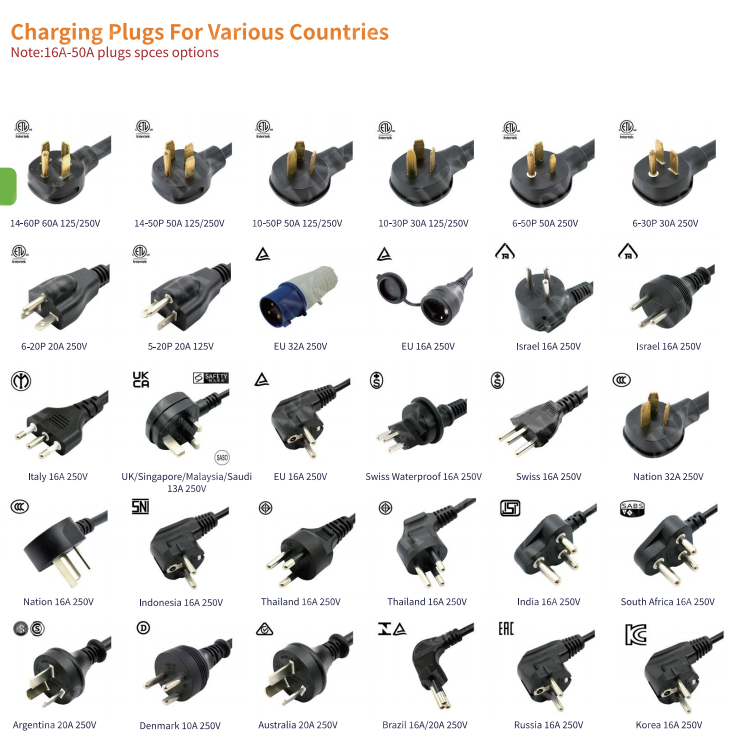
Different markets use different plug systems.
This is why portable EV chargers should not use one universal input plug for every country.
NEMA Plugs for North America
NEMA plugs are common in the United States and Canada.
For portable EV chargers, common options include NEMA 5-15, NEMA 5-20, NEMA 6-20, and NEMA 14-50.
NEMA 5-15 and NEMA 5-20 are often used for lower-power charging.
NEMA 14-50 is widely used for higher-power residential and RV-style charging.
If your target market is North America, the NEMA plug type should be confirmed before production.
Type G Plugs for the UK and Gulf Markets
Type G plugs are widely used in the United Kingdom, Ireland, and many Gulf markets.
They are common in home and light commercial environments.
For portable EV chargers, Type G is usually suitable for lower-power charging.
If the customer needs higher charging power, an industrial socket may be a better option.
Schuko and Type E/F Plugs for Europe
Schuko and Type E/F plugs are common in many European countries.
They are often used for household and light-duty charging applications.
However, not every household socket is suitable for long-time high-current EV charging.
For safer and more stable operation, many buyers choose IEC 60309 industrial plugs for higher current applications.
Type I Plugs for Australia and New Zealand
Type I plugs are common in Australia and New Zealand.
They may come with different current ratings, such as 10A, 15A, or higher industrial versions.
If you are sourcing portable EV chargers for these markets, the current rating should be confirmed clearly.
A 10A plug and a 15A plug may look similar to end users, but they are not the same for charging performance.
GB Plugs for China
In mainland China, portable EV chargers may use GB 10A or GB 16A input plugs.
For higher-power applications, industrial plug options may also be required.
If the product is designed for China or Chinese vehicle export support, the input plug should match local power conditions and user scenarios.
IEC 60309 Industrial Plugs
IEC 60309 industrial plugs are common in commercial, outdoor, campsite, workshop, and fleet charging scenarios.
They are usually more suitable for higher-current and long-duration charging than normal household plugs.
Common options include 16A and 32A versions.
Blue IEC 60309 plugs are commonly used for 200–250V single-phase power.
Red IEC 60309 plugs are commonly used for 380–480V three-phase power.
For project buyers, IEC 60309 is often a practical choice when stable power and higher charging performance are required.
Why Choosing the Right Input Plug Matters
The input plug affects real user experience.
If the plug does not match the local socket, the user cannot charge directly.
If the current rating is too low, the charging speed may not meet expectations.
If the plug quality is poor, long-time charging may cause overheating or safety risks.
If the plug standard is wrong, your product may face complaints, returns, or market access issues.
For portable EV charger buyers, the input plug is not just an accessory. It is part of the complete charging solution.
What Should You Confirm Before Bulk Purchase?
Before buying portable EV chargers in bulk, you should confirm these details:
Target country or region
Local voltage and frequency
Socket type used by end users
Required input current
Charger power level
Cable specification
Certification requirements
Indoor or outdoor use scenario
For example, a portable EV charger for mainland Europe may need a Schuko or IEC 60309 input plug.
A charger for the UK or UAE may need Type G or IEC 60309.
A charger for North America may need a NEMA input plug.
A charger for China may need a GB 10A or GB 16A plug.
If you sell to multiple markets, you may need several input plug versions under the same charger model.
Common Mistakes When Choosing Input Plugs
Many buyers only check the vehicle-side connector.
This is a common mistake.
For example, they may confirm that the charger uses Type 2 on the vehicle side. But they forget to confirm whether the input side should be Schuko, Type G, CEE, or another plug.
Some buyers also choose a plug based only on appearance.
This can create problems because similar-looking plugs may have different current ratings.
Another mistake is using travel adapters for EV charging.
Travel adapters are not designed for long-time high-current EV charging. They may increase overheating and contact risk.
For business buyers, the safest way is to define the input plug at the specification stage.
How OLINK Helps You Choose the Right Input Plug
OLINK is an experienced EV charging manufacturer focused on portable EV chargers, EV charging adapters, AC chargers, DC charging stations, and customized EV charging solutions.
When you source portable EV chargers from OLINK, we help confirm the input plug before production.
We can match the charger with the target market, local voltage, current rating, cable length, and application scenario.
For different markets, OLINK can support multiple input plug options, including NEMA, Type G, Schuko, Type I, GB, and IEC 60309 industrial plugs.
This helps you reduce selection mistakes and improve customer satisfaction.
Recommended Selection Logic
If your customer needs simple home charging, choose a local household plug with a suitable current rating.
If your customer needs faster charging, consider a higher-current outlet or industrial plug.
If your customer uses the charger outdoors, confirm waterproof rating and cable durability.
If your customer uses the charger for fleet or workshop charging, IEC 60309 may be more suitable.
If your product will be sold across multiple countries, prepare different input plug versions for different markets.
FAQ
Can one portable EV charger use different input plugs?
Yes. Some portable EV chargers can be customized with different input plugs for different countries.
However, the charger power, cable rating, and internal design must match the plug rating.
Is a household plug enough for portable EV charging?
It depends on the charging power.
A household plug may be enough for low-power charging. But for higher current and long-time use, an industrial socket is often safer and more stable.
Can users use an adapter to change the input plug?
It is not recommended for EV charging.
Portable EV chargers draw continuous current for a long time. A low-quality adapter may overheat or create contact problems.
Which input plug is better for commercial buyers?
For light-duty use, local household plugs may be enough.
For higher-power or project use, IEC 60309 industrial plugs are usually a better choice.
What information should I provide before ordering?
You should provide the target country, voltage, current, socket type, charger power, and use scenario.
This helps OLINK recommend the correct input plug configuration.
Need Help Matching Input Plugs?
If you are preparing portable EV chargers for different markets, OLINK can help you confirm the right input plug before production.
Tell us your target country, charger power, and customer application.
We will help you match the correct input plug, cable specification, and portable EV charger configuration.
YouTube : https://www.youtube.com/@olinkevse
OLINK : https://olinkevse.com/
