
When purchasing EV charging adapters, many teams do not make mistakes because of power rating.
They make mistakes because of adapter direction.
This is especially common for cross-border vehicle trading teams.
Two product names often look very similar:
CCS2 to GB/T Adapter
GB/T to CCS2 Adapter
The difference is not just the order of words.
It defines how the adapter is used in the real charging scenario.
If the direction is wrong, the adapter may not fit.
The charging handshake may fail.
The project may also face delays, extra costs, or failed delivery tests.
At OLINK, we use a clear naming rule:
The left side is the charger side.
The right side is the vehicle side.
In other words:
A to B = A is the charging station side, and B is the vehicle side.
This rule helps reduce communication errors during procurement.
It is especially useful for vehicle exporters, cross-border traders, fleet projects, and overseas delivery teams.
What Does Adapter Direction Mean?
Adapter direction means which side connects to the charging station and which side connects to the vehicle.
One side connects to the charger.
The other side connects to the EV inlet.
An adapter is not just a physical connector.
It must match the charging standard, connector structure, communication logic, voltage, and current.
Before confirming your purchase, you should ask two basic questions:
What is the charging station connector?
What is the vehicle inlet connector?
Once these two points are clear, the adapter direction becomes much easier to confirm.
OLINK Naming Rule: Charger Side to Vehicle Side
To avoid confusion, OLINK recommends using one simple rule:
Left side = Charger Side / Charging Station Side
Right side = Vehicle Side / EV Inlet Side
For example:
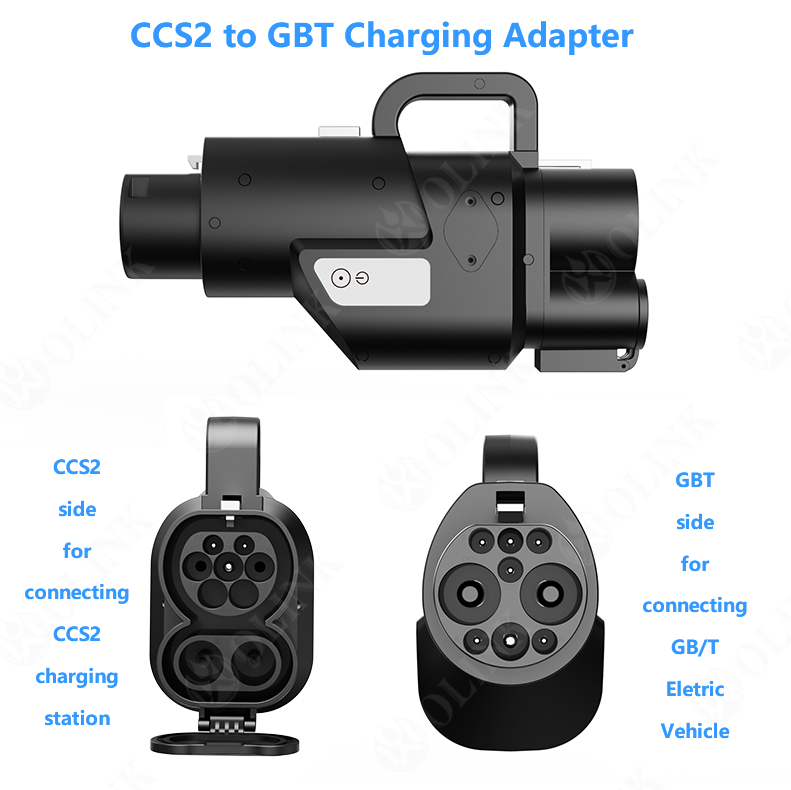
CCS2 to GB/T Adapter means:
CCS2 charging station to GB/T vehicle.
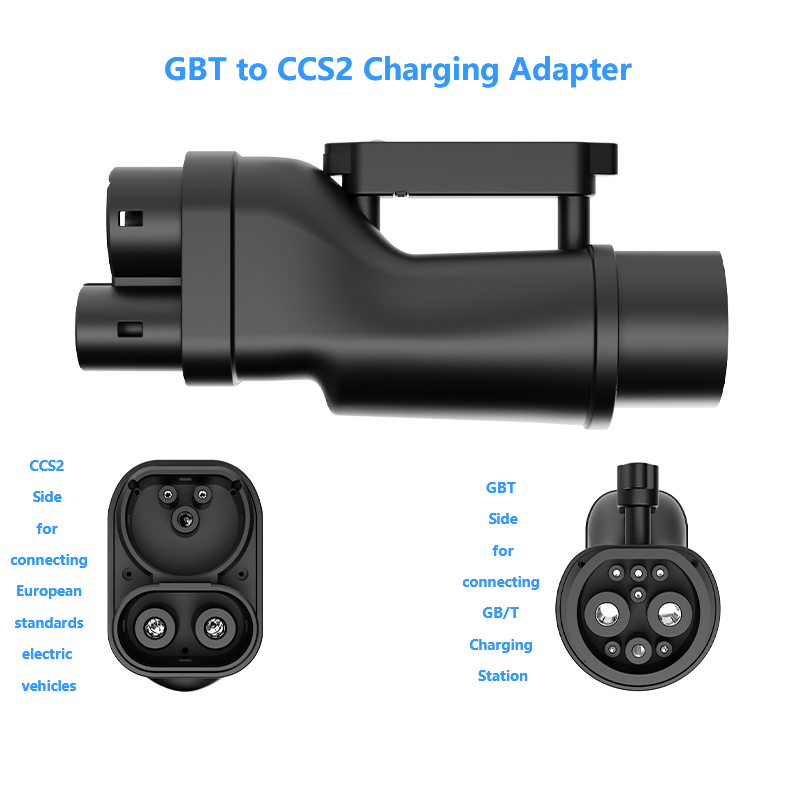
GB/T to CCS2 Adapter means:
GB/T charging station to CCS2 vehicle.
This is not a wording issue.
It is an application direction issue.
If your team only says, “We need a CCS2 and GB/T adapter,” the supplier may misunderstand the requirement.
A more accurate expression is:
We need a CCS2 charger to GB/T vehicle adapter.
Or:
We need a GB/T charger to CCS2 vehicle adapter.
This makes the charger side and vehicle side clear from the beginning.
What Is a CCS2 to GB/T Adapter?
A CCS2 to GB/T Adapter is used in this direction:
CCS2 Charging Station → GB/T Vehicle
This means the adapter connects a CCS2 charging station to a GB/T vehicle.
Typical scenarios include:
Chinese GB/T vehicles exported to Europe.
Chinese GB/T vehicles exported to the Middle East.
GB/T vehicles using local CCS2 DC fast chargers.
Overseas delivery testing for cross-border vehicle projects.
Fleet projects that need GB/T vehicles to use CCS2 charging networks.
For example, you may have a batch of Chinese-standard GB/T electric vehicles.
The destination market uses CCS2 DC fast chargers.
In this case, you need a CCS2 to GB/T Adapter.
The core logic is simple:
Charger side: CCS2
Vehicle side: GB/T
What Is a GB/T to CCS2 Adapter?
A GB/T to CCS2 Adapter is used in this direction:
GB/T Charging Station → CCS2 Vehicle
This means the adapter connects a GB/T charging station to a CCS2 vehicle.
Typical scenarios include:
CCS2 vehicles entering the Chinese market.
CCS2 vehicles tested in a GB/T charging environment.
Laboratory testing with GB/T DC chargers.
Vehicle display projects using local GB/T infrastructure.
Cross-border teams verifying CCS2 vehicle compatibility in China.
For example, you may have a European-standard CCS2 electric vehicle.
You need to test it with a GB/T charger in China.
In this case, you need a GB/T to CCS2 Adapter.
The core logic is:
Charger side: GB/T
Vehicle side: CCS2
CCS2 to GB/T vs GB/T to CCS2: Key Difference
| Item | CCS2 to GB/T Adapter | GB/T to CCS2 Adapter |
|---|---|---|
| Charger Side | CCS2 | GB/T |
| Vehicle Side | GB/T | CCS2 |
| Typical Vehicle | Chinese-standard GB/T EV | European-standard CCS2 EV |
| Typical Charging Environment | Europe, Middle East, or CCS2 networks | China or GB/T charging sites |
| Common Use | GB/T vehicles charging overseas | CCS2 vehicles tested or used with GB/T chargers |
| Correct Purchase Expression | CCS2 charger to GB/T vehicle | GB/T charger to CCS2 vehicle |
The easiest way to avoid mistakes is:
Do not start by looking at where the vehicle comes from.
Start by checking the charging station connector first.
Then confirm the vehicle inlet.
This process helps prevent direction errors before purchase.
What Happens If You Buy the Wrong Direction?
Buying the wrong adapter direction can cause several problems.
The Adapter May Not Physically Fit
Some connector structures are different.
The plug may not fit the charging station or the vehicle inlet.
Even if two connectors look similar, they should not be forced together.
Forced connection may damage pins, housing, or locking parts.
The Charging Handshake May Fail
DC fast charging is not only about power transfer.
The vehicle and charger must complete communication before charging starts.
If the adapter direction is wrong, the vehicle and charger may not recognize each other.
The charging session may fail to start.
The Charger May Show Fault Codes
The charging station may show errors such as communication failure, connection fault, insulation fault, or locking failure.
This makes on-site troubleshooting more difficult.
It can also increase after-sales communication costs.
The Project Timeline May Be Delayed
For cross-border vehicle trading teams, adapter direction errors can delay delivery.
Sample testing, customer acceptance, batch procurement, and on-site demonstration may all be affected.
A small naming mistake can create a serious project loss.
After-Sales Responsibility Becomes Harder to Define
If the charger side and vehicle side were not clearly confirmed before purchase, later troubleshooting becomes complicated.
The customer may think the product is incompatible.
The supplier may find that the ordered direction was wrong.
That is why direction confirmation should happen before payment, not after failure on site.
How to Identify the Correct Adapter Direction Before Purchase
You can follow these steps before confirming your order.
Step 1: Confirm the Charging Station Side
First, confirm the charging station connector.
You need to know whether the charger side is:
CCS2
GB/T
CCS1
NACS
CHAdeMO
Type 2
J1772
If you are not sure, ask the on-site team to take photos of the charging plug.
You can also provide the charger brand, model, nameplate, and project country.
Step 2: Confirm the Vehicle Side
Next, confirm the vehicle inlet.
You need to know whether the vehicle side is:
GB/T DC
CCS2
CCS1
NACS
CHAdeMO
Type 2
J1772
For cross-border vehicles, do not judge only by the vehicle brand.
The same brand may use different charging standards in different markets.
Step 3: Confirm AC or DC Charging
AC adapters and DC adapters cannot be used in the same way.
DC fast charging usually involves higher voltage, higher current, and more complex communication.
Before purchase, you must confirm whether the project requires AC charging or DC fast charging.
If your project involves public fast charging, fleet charging, vehicle delivery, or field testing, it usually requires a DC adapter.
If your project involves home charging, destination charging, or slow charging, it may require an AC adapter.
Step 4: Confirm Rated Voltage and Current
After confirming the direction, you should check whether the electrical specifications match the project.
You should confirm:
Rated voltage
Rated current
Maximum power
Operating temperature
IP protection level
Locking design
Temperature monitoring
Communication compatibility
Correct direction is only the first step.
Correct specifications are the foundation of safe charging.
Step 5: Confirm With Photos Before Payment
At OLINK, we recommend sending three types of photos before purchase:
Charging station plug photo
Vehicle inlet photo
On-site application environment photo
These photos help confirm the adapter direction, connector type, and use scenario.
They also reduce the risk of wrong samples and wrong batch orders.
Typical Scenario 1: Chinese GB/T Vehicles Exported to Europe
If you export Chinese-standard EVs to Europe, the vehicle side may be GB/T.
However, local DC fast charging networks usually use CCS2.
In this case, you should confirm:
Charger side: CCS2
Vehicle side: GB/T
Correct direction: CCS2 to GB/T Adapter
The recommended purchase expression is:
CCS2 charger to GB/T vehicle adapter
This tells the supplier exactly what you need.
Typical Scenario 2: Chinese GB/T Vehicles Exported to the Middle East
The Middle East has mixed charging standards in many markets.
Some charging sites use CCS2, while imported vehicles may use different inlet types.
If the vehicle uses GB/T and the charging station uses CCS2, you need:
CCS2 to GB/T Adapter
For Middle East projects, you should also confirm heat resistance, cable durability, and temperature protection.
High-temperature environments can affect long-term charging stability.
Typical Scenario 3: CCS2 Vehicles Tested in China
If your vehicle uses a CCS2 inlet, but the testing site has GB/T chargers, the correct direction is:
GB/T to CCS2 Adapter
The recommended purchase expression is:
GB/T charger to CCS2 vehicle adapter
This need is common in vehicle import testing, showroom demonstration, and R&D validation.
Why OLINK Uses a Clear Adapter Naming Rule
Cross-border vehicle projects often involve many teams.
The sales team focuses on vehicles.
The technical team focuses on interfaces.
The procurement team focuses on price and delivery.
The on-site team focuses on whether charging works.
If each team understands the adapter direction differently, mistakes can happen easily.
That is why OLINK uses a clear naming rule:
Charger Side to Vehicle Side
Or simply:
Charging station side to vehicle side
For example:
CCS2 to GB/T = CCS2 charger side → GB/T vehicle side
GB/T to CCS2 = GB/T charger side → CCS2 vehicle side
CCS1 to GB/T = CCS1 charger side → GB/T vehicle side
GB/T to CCS1 = GB/T charger side → CCS1 vehicle side
By following this rule, your team can reduce procurement errors and improve communication efficiency.
Quick Purchase Checklist
Before placing an order, use this checklist:
What is the charging station connector?
What is the vehicle inlet connector?
Do you need AC or DC charging?
What is the maximum voltage?
What is the maximum current?
Does the vehicle support the required charging communication?
Is temperature monitoring required?
Is a locking function required?
Do you need sample testing?
Have you provided photos of both the charger side and vehicle side?
If this information is incomplete, it is better to confirm before ordering.
FAQ
Is CCS2 to GB/T the same as GB/T to CCS2?
No.
They are opposite directions and are used in different scenarios.
CCS2 to GB/T is used for CCS2 charging stations and GB/T vehicles.
GB/T to CCS2 is used for GB/T charging stations and CCS2 vehicles.
How do I know which side is the charger side?
Look at the charging plug from the charging station.
If the charging plug is CCS2, the charger side is CCS2.
If the charging plug is GB/T, the charger side is GB/T.
How do I know which side is the vehicle side?
Look at the vehicle charging inlet.
If the vehicle inlet is GB/T, the vehicle side is GB/T.
If the vehicle inlet is CCS2, the vehicle side is CCS2.
Can I use the wrong direction if the plug looks similar?
No.
A wrong-direction adapter may fail to connect, communicate, or start charging.
DC fast charging adapters must match both the physical connector and communication logic.
What information should I send before buying?
You can send the following information:
Vehicle brand and model
Vehicle inlet photo
Charging station plug photo
Project country
AC or DC charging requirement
Target power
Estimated order quantity
Application scenario
OLINK can help confirm the correct adapter direction based on this information.
Confirm Adapter Direction With OLINK
If you are not sure whether you need CCS2 to GB/T or GB/T to CCS2, confirm the charger side and vehicle side first.
You can send OLINK the vehicle inlet photo, charging station plug photo, and project country.
We will help you confirm the correct adapter direction based on the rule:
Charger Side to Vehicle Side
